“Lightweight GraphRAG” is an accurate label for LightRAG, but it encourages the wrong comparison. It sounds like a smaller implementation of Microsoft's pipeline.
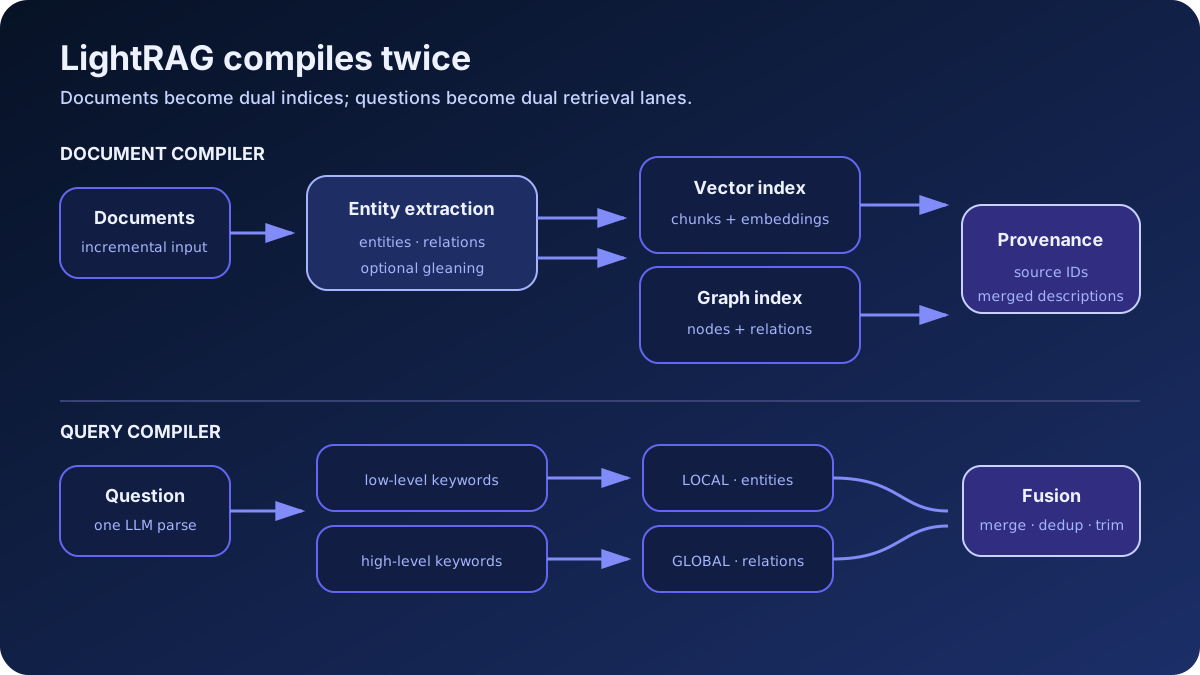
The current source is easier to understand as a two-stage compiler. Documents compile into graph and vector intermediate representations. Queries compile into low-level and high-level keyword lanes that select different retrieval operators.
Document compilation
After chunking, the extraction phase asks a model to identify entities and relations for each chunk. The parser supports structured JSON as well as delimiter-based output, and it can perform an additional gleaning pass when configured.
Extracted records then pass through deterministic merge logic:
- entities with the same identity are consolidated;
- relation endpoints and descriptions are merged;
- long descriptions may be summarized to fit storage limits;
- source chunk IDs are retained as provenance;
- graph nodes and edges are written to graph storage;
- entity, relation, and chunk representations are written to vector storage;
- document status tracks incremental ingestion.
The key operational property is incremental merge. Adding a document does not require rebuilding a global community hierarchy from scratch. New chunks enrich or extend existing nodes and edges.
That makes the system practical for a corpus that changes continuously, although it also means early extraction mistakes can become durable graph structure.
Query compilation
kg_query first asks the model to extract two keyword sets from the user's question:
- low-level keywords identify concrete entities and details;
- high-level keywords identify themes and relationships.
The retrieval modes are compositions of those lanes:
localbegins with entities found from low-level keywords;globalbegins with relations found from high-level keywords;hybridcombines graph evidence from both;naiverelies on chunk-vector retrieval;mixcombines graph evidence with raw vector chunks and is the current default.
The resulting entities, relations, and chunks are deduplicated and interleaved before token-budget truncation. This matters: simply concatenating one retrieval list after another would let the first store consume the context budget. Round-robin-style merging preserves diversity across evidence types.
The final model therefore receives three layers: structured entities, structured relations, and source text. The graph supplies navigation; vectors supply semantic proximity; chunks supply quotable evidence.
Where the errors move
The architecture does not make graph construction free. It moves retrieval risk into several inspectable stages:
- entity and relation extraction;
- identity merge and description summarization;
- high-level versus low-level keyword decomposition;
- storage-specific retrieval;
- fusion and token truncation.
An entity extraction error becomes structured and can propagate through many queries. A dropped qualifier in a merged description can change the apparent relation. A query-classification error can send a valid question down the wrong lane.
That suggests a better evaluation strategy than final-answer accuracy alone. Each compilation stage should have fixtures and metrics: extraction precision, merge stability, keyword routing, provenance coverage, and evidence survival after truncation.
It is also why claims such as “half the code for the same recall” should be treated cautiously. LightRAG's verifiable strength is a coherent, incremental dual-index protocol. Performance equivalence depends on corpus, extraction model, storage backend, and query distribution.
Personal take
LightRAG will resonate with small teams working on relation-heavy corpora: research literature, regulations, supply chains, software architecture, and event or people databases. It lowers the operational threshold for graph-assisted retrieval without requiring a dedicated knowledge-graph organization.
The market effect will be the quiet normalization of graphs. Products may stop advertising “knowledge graphs” because graph retrieval will simply become one backend lane. The expensive part will shift from graph database licensing to extraction quality, incremental repair, and evaluation.
My broader takeaway is that retrieval systems should be loyal to question structure, not to one index. Finding a specific entity and explaining a global relationship are different operations. LightRAG's durable idea is not merely graph plus vector; it is compiling the question before choosing the evidence path.