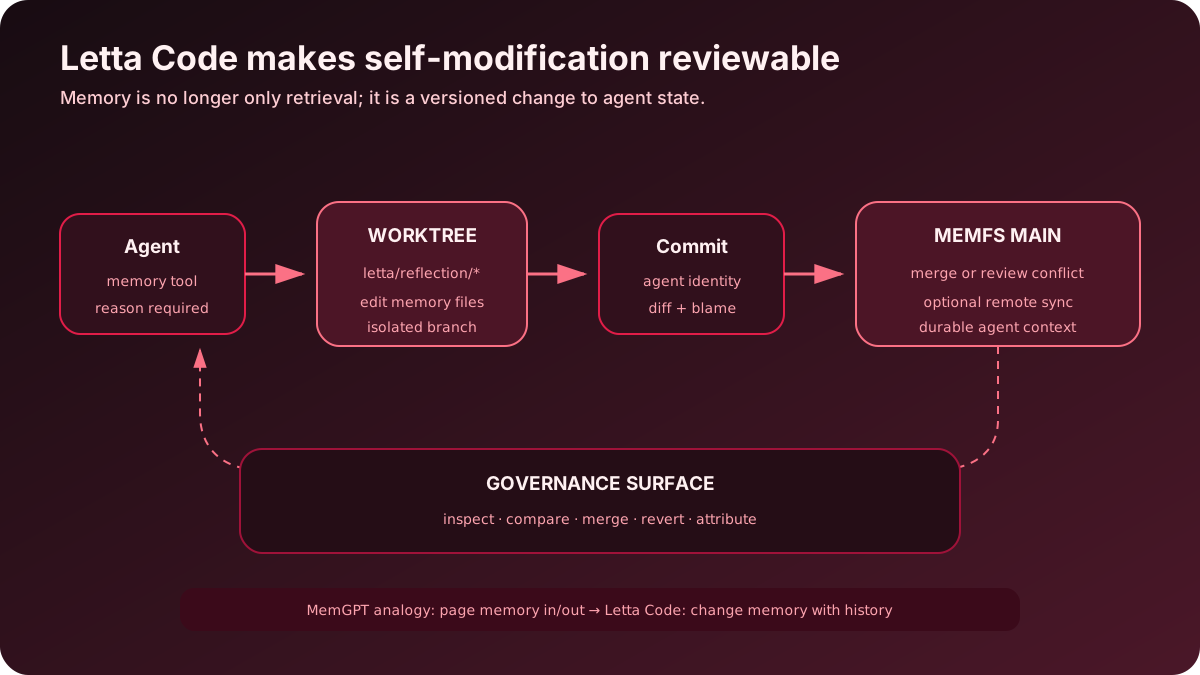
MemGPT's virtual-memory analogy was powerful: the context window is RAM, external storage is disk, and the agent learns to page information in and out. That model made state management part of agent behavior rather than an application-side retrieval trick.
The active Letta architecture has moved beyond that analogy. The original letta repository now identifies itself as a legacy API server; active development is in Letta Code and the newer Agent SDK. In Letta Code, durable agent context can live in MemFS, a Git-backed memory filesystem.
Memory is becoming versioned self-modification.
A memory write becomes a change set
The memory tool does not merely accept content. It requires a reason. A successful modification creates a Git commit with agent identity, producing a durable diff and attribution record.
That changes the unit of memory from “a fact retrieved at runtime” to “a reviewed modification of future context.” Persona files, user information, skills, and other prompt assets can all affect later behavior. Treating their mutation like source-code mutation is therefore reasonable.
Git provides several properties almost for free:
- a content-addressed history;
- human-readable diffs;
- authorship and timestamps;
- rollback;
- branch isolation;
- merge conflict detection.
The important contribution is not using a fashionable developer tool. It is making behavioral changes inspectable with an existing, well-understood consistency model.
Reflection runs in a worktree
Background reflection creates a branch named like letta/reflection/<id> and a separate worktree rooted under the agent's memory area. The reflection subagent edits and commits inside that scope instead of modifying the primary memory tree directly.
Finalization can then distinguish several outcomes:
- no-op reflection: remove the worktree;
- clean committed change: merge into the primary memory branch;
- conflict: abort the merge and preserve the worktree for inspection;
- dirty or failed work: keep or clean it according to the retry policy rather than pretending persistence succeeded.
This is a concrete concurrency model. The active agent and the background reflection process do not race over the same files. They produce branches that must reconcile.
The worktree boundary also composes with sandbox policy: a reflection subagent can receive an exact writable memory scope plus the Git metadata required to commit, without gaining arbitrary access to the parent agent directory.
Memory governance replaces retrieval-only thinking
Vector memory asks, “Which item is relevant to this turn?” Git-backed memory adds, “Who may alter the context that will shape every future turn?”
That creates new control points:
- direct writes versus proposed writes;
- branch and merge policy;
- agent identity in commit metadata;
- remote MemFS synchronization;
- conflict ownership;
- retention of failed or unmerged changes.
The system does not make the model correct. It makes incorrect self-modification less invisible.
There is a product challenge: Git is a good storage and governance substrate, not a mass-market interface. Users should see “The agent wants to change this memory for this reason” rather than a raw merge conflict. The UI can simplify the vocabulary without discarding the underlying audit trail.
Personal take
Letta Code will resonate first with developers, researchers, and teams operating long-lived agents. They already understand why a change history is worth some process overhead. Consumer adoption will depend on translating branches and commits into understandable review moments.
I expect a new operational role to emerge: the memory maintainer. This person or service will review how an agent's durable preferences evolve, resolve conflicting context, and recover from poisoned memories. The role will matter in enterprise knowledge, healthcare assistance, and personal digital representatives.
Versioning also changes accountability. “The model changed” is usually too vague to investigate. When persona and memory changes have commits, a behavioral regression may be traced to a specific modification. Governance then becomes similar to production engineering: not the fantasy of never making a mistake, but the ability to identify, review, and reverse every consequential change.